Washington ignores America's fiscal cliff
· Axios
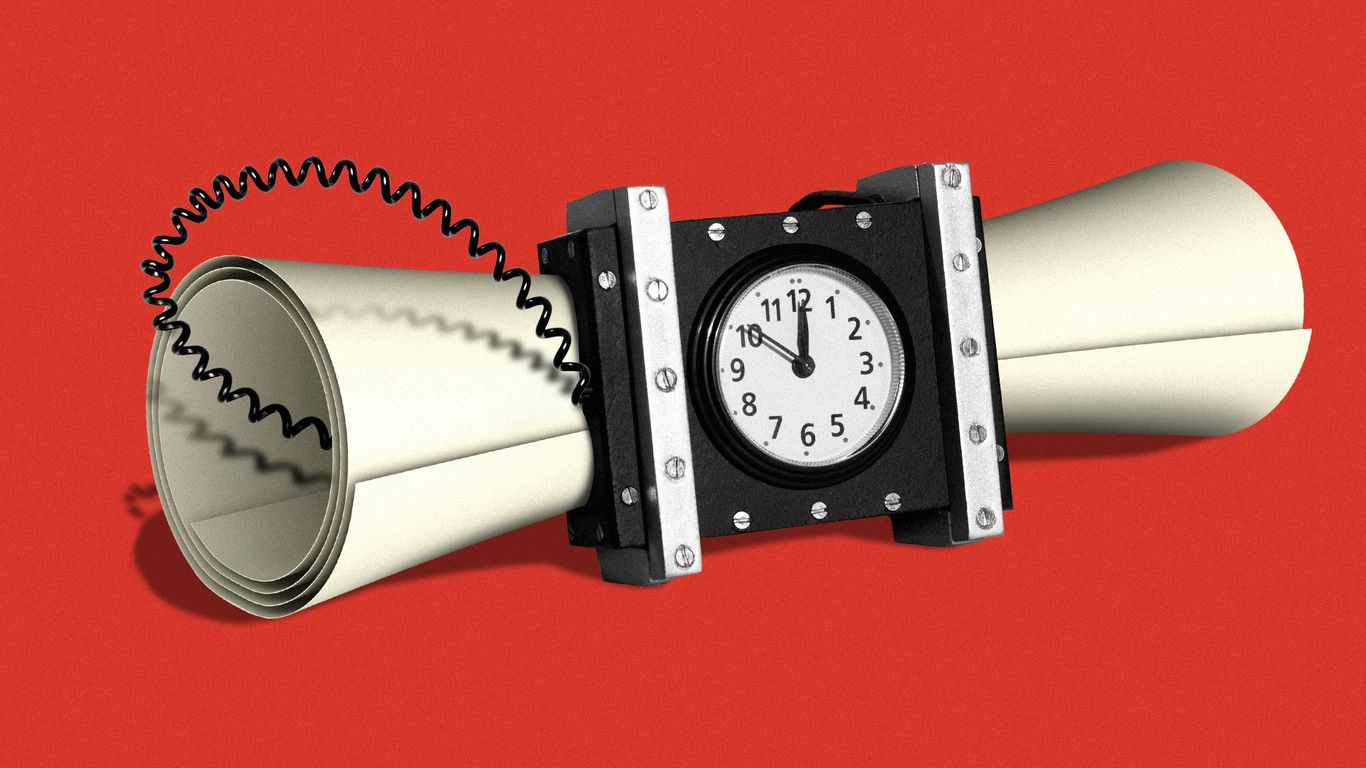
The United States faces a dire and unsustainable fiscal outlook. You'd never know it from the action in Washington.
- Across parties and policy areas, you'd never guess that the U.S. faces fiscal constraints created by its high-and-rising public debt, ballooning deficits without precedent in times of prosperity, and a looming entitlement spending crisis when the Social Security trust fund runs out.
State of play: Consider, instead, recent policy developments that will meaningfully affect the fiscal picture for the worse.
Visit bettingx.bond for more information.
- The Trump administration is seeking $200 billion to fund the Iran war and replenish depleted weaponry.
- The Supreme Court struck down the administration's use of emergency authority to impose tariffs, and legal battles are underway over refunds of import taxes already paid.
- For all the attention on DOGE one year ago, there has been little evidence of lasting restraint of federal spending. Caps on discretionary spending for the 2024 and 2025 fiscal years, part of a spending deal in 2023, weren't extended.
Zoom in: That all follows tax legislation enacted last year that the Congressional Budget Office scored as increasing cumulative deficits by $3.4 trillion over a decade, with backloaded spending cuts that are smaller than combined tax cuts.
- Even if Democrats gain power in Congress in the midterms or the White House in 2029, some of the party's lawmakers are emphasizing the possibility of further tax cuts.
- Sens. Chris Van Hollen (D-Md.) and Cory Booker (D-N.J.) have announced proposals that would cut taxes on middle- and upper-middle-class households.
By the numbers: If you just listened to the discourse around policies that threaten to bust the budget, you might assume the U.S. fiscal situation was broadly stable, giving policies room to maneuver. That's not what the arithmetic says.
- The CBO is projecting deficits of around 6% of GDP each year for the next decade — numbers that predate the Iran war or Supreme Court tariff ruling.
- Other than in recent years, deficits of that scale have only been seen in times of economic crisis or major war.
- Those same CBO projections have the public debt soaring to 120% of GDP by 2036, compared to about 100% now. The all-time record for federal debt was 106% of GDP, reached during World War II.
Debt service costs are on track to soar to more than $2 trillion a year in 2036 — a historically high 4.6% of the economy.
- Social Security could run out of funds in 2032, resulting in a politically toxic cut in payouts if Congress can't agree to extend benefits.
Between the lines: In the 2010s, with interest rates and inflation perpetually low, there was a bipartisan sense that super-sized deficits were no big deal — and potentially desirable.
- The macroeconomics flipped. The political discourse hasn't.
- Inflation has been elevated for five straight years and interest rates have proven stubbornly higher, as has the accumulated debt.
What they're saying: "Everything just keeps making things worse," Maya MacGuineas, president of the Committee for a Responsible Federal Budget, tells Axios. "There has not been any serious discussion of where to generate real savings."
- "The period where you could pretend that deficits don't matter is a bygone era, and yet the policy behavior is not better in response to that," she adds. "It's actually worse."
Of note: There've been congressional efforts to jump-start a bipartisan process to address America's fiscal imbalance, including a "Fiscal Commission Act" introduced this month by Sens. Todd Young (R-Ind.), John Curtis (R-Utah) and Angus King (I-Maine), with several co-sponsors.
- So far, though, there's little evidence that this broad goal is aligned with concrete policy decisions enacted by the full Congress.
The bottom line: America's fiscal health is miserable. Nobody in Washington is acting like it.
- Go deeper: "Iran war is new test of America's economic superpower."